The Power of Mantra Chanting: Benefits, Techniques, and Its Relevance in Modern Life
Introduction: What Is Mantra Chanting?
In the journey of spiritual growth, few tools are as powerful and accessible as Mantra Chanting. A “Mantra” is not just a word; it is a sound vibration that uplifts the consciousness.
The word itself comes from Sanskrit: Man (mind) and Tra (to free or protect). Therefore, Mantra Chanting is a practice that frees the mind from worry and protects it from negativity.
It serves a simple purpose: to quiet the mental noise and bring us back to a state of inner peace. It is a universal practice that helps align our energy with the rhythm of nature.
History of Mantra Chanting in Ancient India
The origin of Mantra Chanting dates back thousands of years to the dawn of Indian civilization. Ancient Rishis (sages) discovered that everything in the universe, including our bodies, is made of energy and vibration.
They realized that specific sounds could heal the body and calm the mind. These sounds were preserved orally for generations.
From the banks of the Saraswati River to the Himalayan peaks, chanting was the primary method used by early civilizations to connect with the divine and maintain social harmony.
Mantra Chanting in the Four Vedas and Puranas
The Vedas are the treasure house of ancient Indian meditation wisdom. They provide the foundation for understanding sound.
Mantra Chanting in the Vedas:
* Rig Veda: The oldest scripture, it contains thousands of hymns. It teaches that the spoken word has power. Chanting these verses is believed to invoke cosmic energies.
* Yajur Veda: This focuses on rituals and action. It uses mantras to discipline the mind, ensuring that our actions are performed with awareness and focus.
* Sama Veda: Known as the Veda of melodies. It transforms mantras into music. It teaches that chanting with devotion and melody can lead to deep spiritual ecstasy.
* Atharva Veda: This applies mantras to daily life. It contains chants for health, protection, and overcoming anxiety, bridging the gap between the spiritual and the practical.
Mantra Chanting in the Puranas:
The Puranas simplified these deep concepts for the common man. They introduced the idea of Nama Japa (chanting the name of the divine). They teach that simple devotion through chanting is enough to purify the heart.
Types of Mantra Chanting
While the core practice is the same, there are different ways to approach chanting depending on your needs.
- Mindfulness Chanting
This involves chanting while being fully aware of the sound. You do not just repeat the word; you listen to it. This keeps the mind present and prevents it from wandering to the past or future.
- Mantra Meditation (Japa)
This is the repetition of a specific sound, often using a string of beads (Mala). It provides a focal point. The repetition creates a rhythm that naturally slows down the breath and heart rate.
- Breath Awareness Chanting
Here, the mantra is synchronized with the breath. For example, you might chant silently on the inhale and audibly on the exhale. This unites the body’s life force (Prana) with the mind.
- Guided Mantra Chanting
Ideal for beginners, this involves listening to a teacher or recording. You follow along with the rhythm and pitch. It is excellent for learning proper pronunciation and feeling supported in the practice.
Techniques for Spiritual Growth and Mental Peace
You do not need to be an expert to start. Simplicity is the key to spiritual growth.
Basic Steps for Beginners:
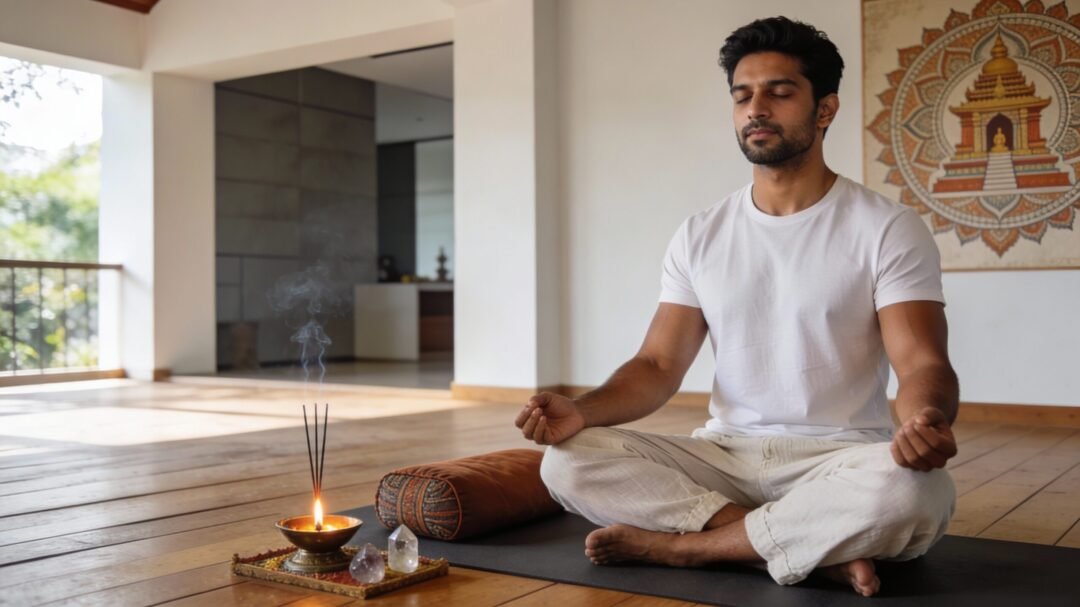
* Preparation: Sit in a comfortable posture (like Sukhasana or on a chair). Keep your back straight.
* Intention: Close your eyes and set a positive intention for your practice.
* The Chant: Choose a simple mantra like “Om” or “Om Shanti.”
* Vibration: Take a deep breath and chant slowly. Feel the vibration of the sound rising from your naval to your throat.
* Silence: After a few minutes of chanting, sit in silence. Absorb the peace that follows the sound.
Consistency matters more than duration. Ten minutes of daily practice is better than an hour once a week.
Why Mantra Chanting Is Important in Modern Life
We live in a time of high stress and digital overload. Our senses are constantly bombarded with notifications, noise, and demands.
This fast lifestyle often leads to burnout and anxiety. Mantra Chanting acts as a shield. It cuts through the external noise and helps us find our center.
It provides meditation for stress relief that is accessible anytime. Whether you are stuck in traffic or waiting for a meeting, a silent mantra can instantly restore balance.
Scientific Reasons and Observed Benefits
Modern science is beginning to validate what Yogis have known for ages. Chanting is not just spiritual; it is physiological.
* Vagus Nerve Stimulation: The vibration from chanting (especially the “mmm” sound) stimulates the Vagus nerve, which promotes relaxation.
* Mental Calmness: Repetitive sound synchronizes the left and right hemispheres of the brain, improving focus.
* Emotional Regulation: It reduces cortisol (stress hormones), helping to manage anger and fear.
* Improved Well-being: The rhythmic breathing associated with chanting boosts oxygen levels in the blood.
Note: These benefits support holistic health but are not a substitute for medical treatment.
Benefits of Mantra Chanting for All Age Groups
For Children:
It improves memory power and concentration. It helps channel their energy positively and reduces restlessness.
For Students and Professionals:
It sharpens the intellect and reduces exam or deadline pressure. It cultivates the self-discipline needed for success.
For Senior Citizens:
It offers deep emotional support. It improves cognitive health and provides a sense of connection and inner purpose.
Best Environment for Mantra Chanting
Your environment influences your mind. Creating a sacred space enhances the practice.
* Space: Choose a clean, clutter-free area. According to Vastushastra, a space in the North-East is ideal for spiritual activities.
* Atmosphere: Ensure the room has fresh air and natural light.
* Posture: Sit comfortably. If you cannot sit on the floor, a chair is perfectly fine. The most important thing is an upright spine.
* Time: Early morning (Brahma Muhurta) or twilight are considered the most potent times, but any quiet time works.
Do’s and Don’ts of Mantra Chanting
Do:
* Pronounce Clearly: Try to get the sound right, as the vibration matters.
* Be Patient: It takes time to tame the mind.
* Feel the Meaning: Connect emotionally with the sound you are making.
Don’t:
* Don’t Rush: Chanting is not a race. Slow, steady repetition is more effective.
* Don’t Strain: Your voice should be relaxed, not loud or forced.
* Don’t Judge: If your mind wanders, gently bring it back to the mantra without criticism.
Relevance of Mantra Chanting in Today’s Era
In a world striving for social harmony, change begins with the individual. A stressed individual creates a stressed society; a peaceful individual contributes to peace.
Mantra Chanting fosters ethical living and emotional stability. It helps us disconnect from greed and anger, and reconnect with compassion.
It bridges the gap between ancient wisdom and modern needs, offering a practical solution for a balanced lifestyle.
Conclusion: Mantra Chanting as a Way of Life
Mantra Chanting is more than a technique; it is a lifelong support system. It is a friend that is always with you, ready to provide comfort and clarity.
By dedicating just a few minutes a day to this practice, you invite mental peace and awareness into your life.
Let the vibration of the mantra heal you. Embrace this timeless tradition and discover the silence that lies within the sound.
Here is a curated list of 15–20 essential Hindu Mantras for daily chanting. These cover the major deities and universal prayers for peace, health, and prosperity. They are categorized to help you incorporate them into a daily routine.
Morning Mantras (For Waking Up & Positive Energy)
- Karagre Vasate Lakshmi (Morning Prayer)
* Mantra:
kara-gre vasate lakṣmī, kara-madhye sarasvatī |
kara-mūle tu govinda, prabhāte kara-darśanam ||
* Meaning: On the tip of my fingers resides Lakshmi (Wealth), in the center Saraswati (Knowledge), and at the base Govinda (God). I look at my palms this morning with reverence.
* Purpose: To start the day with gratitude and awareness of one’s own capability (Karma).
- Gayatri Mantra (For Intelligence & Illumination)
* Mantra:
om bhūr bhuvaḥ svaḥ |
tat savitur vareṇyaṃ |
bhargo devasya dhīmahi |
dhiyo yo naḥ pracodayāt ||
* Meaning: We meditate on the glory of the Creator; who has created the Universe; who is worthy of Worship; who is the embodiment of Knowledge and Light; who is the remover of all Sin and Ignorance. May He enlighten our Intellect.
* Purpose: Mental clarity, wisdom, and spiritual awakening.
- Ganesha Mantra (For Removal of Obstacles)
* Mantra:
om gaṃ gaṇapataye namaḥ
* Meaning: I bow to Lord Ganesha, the Lord of the Ganas (armies) and remover of obstacles.
* Purpose: To be chanted before starting any new work or journey to remove hurdles.
- Vakratunda Mantra (For Success)
* Mantra:
vakratuṇḍa mahākāya sūryakoṭi samaprabha |
nirvighnaṃ kuru me deva sarvakāryeṣu sarvadā ||
* Meaning: O Lord with the curved trunk and immense body, whose brilliance rivals a crore suns, please make all my undertakings free from obstacles, always.
* Purpose: Success in all endeavors.
Deity-Specific Mantras (For Devotion & Strength)
- Shiva Mantra (Panchakshari)
* Mantra:
om namaḥ śivāya
* Meaning: I bow to Shiva (The Auspicious One).
* Purpose: Inner peace, self-realization, and dissolving the ego.
- Mahamrityunjaya Mantra (For Health & Protection)
* Mantra:
om tryambakaṃ yajāmahe sugandhiṃ puṣṭi-vardhanam |
urvārukam-iva bandhanān mṛtyor-mukṣīya mā’mṛtāt ||
* Meaning: We worship the Three-Eyed One (Shiva), who is fragrant and nourishes all beings. May He liberate us from death (and the cycle of rebirth) for the sake of immortality, just as a cucumber is severed from its bondage (the vine).
* Purpose: Good health, longevity, and protection from accidents/illness.
- Vishnu Mantra (For Preservation & Peace)
* Mantra:
om namo bhagavate vāsudevāya
* Meaning: I bow to the Lord Vasudeva (Vishnu), who dwells in the hearts of all.
* Purpose: Peace of mind, spiritual liberation, and family harmony.
- Krishna Maha Mantra (For Joy & Love)
* Mantra:
hare kṛṣṇa hare kṛṣṇa, kṛṣṇa kṛṣṇa hare hare |
hare rāma hare rāma, rāma rāma hare hare ||
* Meaning: O Energy of the Lord (Hare), O All-Attractive (Krishna), O Supreme Enjoyer (Rama), please engage me in Your service.
* Purpose: Pure love, devotion, and cleansing of the mind.
- Rama Mantra (For Protection & righteousness)
* Mantra:
śrī rāma jaya rāma jaya jaya rāma
* Meaning: Victory to Lord Rama.
* Purpose: Overcoming fear, building strength of character, and protection.
- Hanuman Mantra (For Courage)
* Mantra:
om hanumate namaḥ
* Meaning: I bow to Lord Hanuman.
* Purpose: Physical strength, courage, and removal of fear/anxiety.
- Durga Mantra (For Shakti/Power)
* Mantra:
om duṃ durgāyai namaḥ
* Meaning: I bow to Mother Durga, the remover of difficulties.
* Purpose: Protection from negative energies and building inner strength.
- Saraswati Mantra (For Knowledge & Education)
* Mantra:
om aiṃ sarasvatyai namaḥ
* Meaning: I bow to Goddess Saraswati (Embodiment of Wisdom).
* Purpose: Focus in studies, artistic skills, and clarity of speech.
- Lakshmi Mantra (For Prosperity)
* Mantra:
om śrīṃ mahālakṣmyai namaḥ
* Meaning: I bow to Goddess Mahalakshmi.
* Purpose: Wealth, abundance, and financial stability.
- Subramanya/Murugan Mantra (For Confidence)
* Mantra:
om śaravaṇa bhavāya namaḥ
* Meaning: Salutations to the son of Shiva, born in the Saravana lake.
* Purpose: Gaining confidence, leadership skills, and vitality.
Evening & Universal Peace Mantras
- Shanti Mantra (For Peace in Education/Work)
* Mantra:
om saha nāvavatu | saha nau bhunaktu |
saha vīryaṃ karavāvahai |
tejasvi nāvadhītam-astu mā vidviṣāvahai ||
om śāntiḥ śāntiḥ śāntiḥ ||
* Meaning: May He protect us both (Teacher and Student). May He nourish us both. May we work together with great energy. May our study be enlightening. May there be no hatred between us. Om Peace, Peace, Peace.
* Purpose: Harmony in relationships and successful teamwork.
- Asato Ma Sadgamaya (For Guidance)
* Mantra:
asato mā sadgamaya |
tamaso mā jyotirgamaya |
mṛtyor-mā’mṛtaṃ gamaya ||
* Meaning: Lead me from the unreal to the Real; from darkness (ignorance) to Light (knowledge); from death to Immortality.
* Purpose: Spiritual guidance and clarity during difficult times.
- Sarve Bhavantu Sukhinah (Universal Well-being)
* Mantra:
sarve bhavantu sukhinaḥ | sarve santu nirāmayāḥ |
sarve bhadrāṇi paśyantu | mā kaścid-duḥkha-bhāg-bhavet ||
* Meaning: May all be happy. May all be free from illness. May all see what is auspicious. May no one suffer.
* Purpose: Cultivating compassion and wishing good for the world.
- Universal Peace Chant
* Mantra:
om śāntiḥ śāntiḥ śāntiḥ
* Meaning: Om Peace, Peace, Peace. (Peace in the body, peace in the mind, peace in the soul).
* Purpose: To end any prayer or stressful situation with calmness.