Agnihotra Hom (Yagna): Spiritual Importance, Vedic Roots, and Its Relevance in the Modern Era
In our fast-paced modern world, ancient wisdom often holds the keys to inner peace and harmony. Among the sacred practices of Sanatan Dharma, Agnihotra Hom stands as a beautiful bridge between our spiritual heritage and contemporary life.
This simple yet profound Vedic fire ritual has been practiced for thousands of years. Today, it offers us a path to connect with nature, purify our surroundings, and find balance in our daily lives.
Introduction to Agnihotra Hom (Yagna)
Agnihotra is a sacred fire ritual that forms the foundation of all Vedic practices. The word “Agnihotra” comes from two Sanskrit terms: “Agni” meaning fire, and “Hotra” meaning healing or offering.
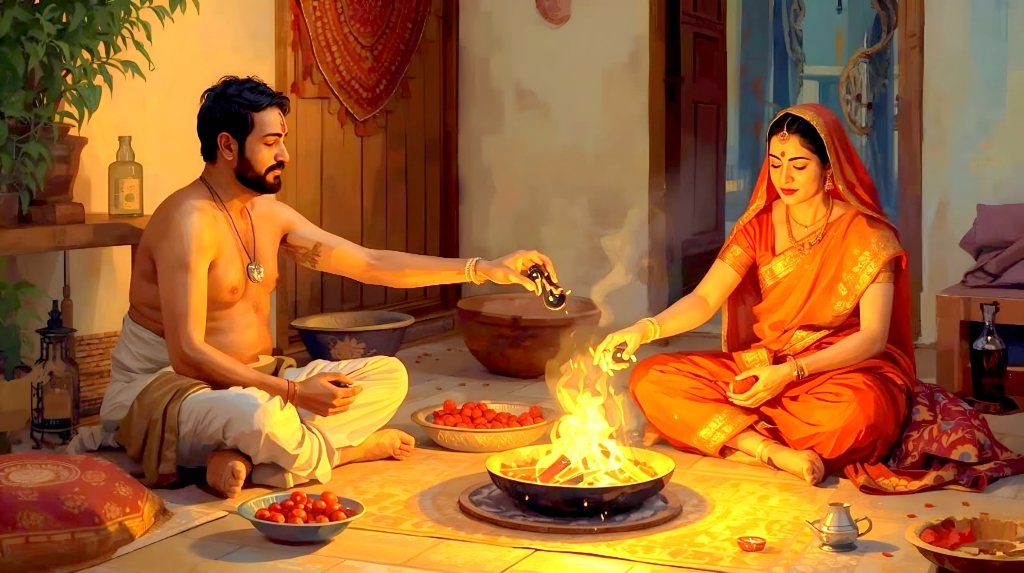
This ancient practice involves making offerings to sacred fire at specific times of the day. It’s performed during sunrise and sunset, aligning our daily rhythm with nature’s cycles.
Unlike complex rituals, Agnihotra is beautifully simple. Anyone can learn and practice it at home with basic materials and sincere intention.
The ritual creates a harmonious atmosphere that benefits not just the practitioner, but the entire surrounding environment.
Spiritual and Cultural Importance of Agnihotra
Agnihotra holds deep spiritual significance in Indian culture. It represents our connection with the five elements of nature – earth, water, fire, air, and space.
The sacred fire serves as a medium to communicate with divine energies. Through this practice, we express gratitude to the sun, which sustains all life on Earth.
Culturally, Agnihotra has been the cornerstone of Vedic lifestyle. Ancient sages understood that regular fire rituals purify both the environment and the human mind.
This practice teaches us discipline, punctuality, and respect for natural cycles. It reminds us that we are part of a larger cosmic order.
Vedic References and Ancient Wisdom
The Rig Veda, our oldest sacred text, contains numerous hymns praising Agni (fire) as a divine messenger. These verses describe fire as the purifier and protector of all beings.
The Yajur Veda provides detailed instructions for performing various fire rituals. It explains how Agnihotra creates positive vibrations that benefit the entire atmosphere.
The Atharva Veda mentions the healing properties of Agnihotra. It describes how this practice can bring peace, prosperity, and good health to practitioners and their communities.
These ancient texts present Agnihotra not as mere ritual, but as a scientific method for environmental and personal purification.
Connection with Sanatan Dharma and Vedic Traditions
Agnihotra embodies the core principles of Sanatan Dharma – living in harmony with nature and recognizing the divine in all creation.
This practice reflects the Vedic understanding that human actions should contribute positively to the world around us. Every Agnihotra ceremony is an act of service to creation.
The ritual connects us with our ancestral wisdom while remaining relevant for modern times. It represents the eternal nature of dharmic practices.
Through Agnihotra, we participate in the ancient Vedic tradition of Yagna – the principle of giving more than we take from nature.
When and Why Agnihotra is Performed
Agnihotra is traditionally performed twice daily – at sunrise and sunset. These times are considered most auspicious as they represent the transition between day and night.
The sunrise ceremony, called Surya Agnihotra, welcomes the life-giving energy of the sun. The sunset ritual, Sandhya Agnihotra, expresses gratitude for the day’s blessings.
These timings align with natural biorhythms, helping practitioners maintain physical and mental balance. The practice creates a sacred routine that brings structure to daily life.
Many people also perform Agnihotra during special occasions, festivals, or when seeking healing and purification for themselves or their environment.
Materials Required (Samagri) – Simple and Natural
The beauty of Agnihotra lies in its simplicity. You need only basic, natural materials:
Copper Pyramid Vessel: A small, pyramid-shaped copper container that conducts positive energy efficiently.
Dried Cow Dung: Pure, organic fuel that burns cleanly and creates beneficial smoke.
Ghee (Clarified Butter): A few drops of pure cow ghee to enhance the sacred fire.
Rice Grains: A pinch of unbroken rice as an offering, symbolizing abundance and gratitude.
These materials are easily available and affordable, making Agnihotra accessible to everyone regardless of economic status.
Step-by-Step Procedure (Vidhi) for Home Practice
Preparation: Place the copper pyramid on a clean surface facing east. Light the dried cow dung using natural methods if possible.
Timing: Begin the ritual exactly at sunrise or sunset. Use accurate timing for best results.
Offering: When the fire is ready, add a few drops of ghee while chanting the Agnihotra mantras.
Rice Offering: At the word “Swaha” in each mantra, offer a pinch of rice into the fire.
Completion: Sit quietly for a few minutes after the ritual, absorbing the peaceful atmosphere created.
Ash Collection: Collect the ash after cooling – it can be used for plants or kept for its purifying properties.
Agnihotra Mantras with Simple Meanings
Morning Mantra: “Sooryaya Swaha, Sooryaya Idam Na Mama”
Meaning: “I offer this to the Sun. This offering is not for my ego, but for the welfare of all.”
Evening Mantra: “Agnaye Swaha, Agnaye Idam Na Mama”
Meaning: “I offer this to Fire. This offering is not for personal gain, but for universal benefit.”
These mantras embody the spirit of selfless service and gratitude that defines true spiritual practice.
Below are the traditionally accepted FULL Agnihotra mantras in pure Sanskrit, given separately for Morning (Sunrise) and Evening (Sunset).
These are the complete mantras, not the short offering lines alone.
🌅 Agnihotra Full Mantra – Morning (Sunrise)
सूर्याय स्वाहा ।
सूर्याय इदं न मम ॥
प्रजापतये स्वाहा ।
प्रजापतये इदं न मम ॥
How it is used:
- At exact sunrise
- First offering with the first two lines
- Second offering with the next two lines
🌇 Agnihotra Full Mantra – Evening (Sunset)
अग्निये स्वाहा ।
इदं न मम ॥
प्रजापतये स्वाहा ।
प्रजापतये इदं न मम ॥
How it is used:
- At exact sunset
- First offering with the first two lines
- Second offering with the next two lines
🔥 Meaning in Simple Words (for understanding)
- अयं अग्निः – This sacred fire
- स्वाहा – I offer with reverence
- इदं न मम – This is not for me (offered selflessly)
The mantra teaches selflessness, surrender, and gratitude, which are core values of Sanatan Dharma and Vedic Parampara.
🕉️ Important Guidance
- Chant slowly and clearly
- No loud shouting or speed chanting
- Offer rice mixed with cow ghee
- Sit quietly for a few minutes after completion
- This full mantra is sufficient for daily Agnihotra
Top of Form
Bottom of Form
Reasons to Practice Agnihotra in Today’s Lifestyle
Modern life often disconnects us from natural rhythms. Agnihotra helps restore this vital connection through daily practice.
In our polluted urban environments, this ritual creates pockets of pure, positive energy that benefit everyone nearby.
The practice provides a peaceful break from digital distractions and mental stress. It offers moments of mindfulness in our busy schedules.
Agnihotra teaches patience, discipline, and consistency – qualities essential for success in any field of life.
Benefits and Positive Effects in the Modern Era
Environmental Benefits: Agnihotra smoke neutralizes harmful pollutants and creates fresher air quality in the immediate area.
Mental Benefits: Regular practice reduces stress, anxiety, and promotes emotional stability through its calming effects.
Physical Benefits: Many practitioners report improved sleep, better respiratory health, and increased energy levels.
Social Benefits: Homes where Agnihotra is practiced often experience more harmony, better relationships, and positive atmospheres.
Scientific and Observational Evidence
While maintaining respect for traditional knowledge, some modern observations support Agnihotra’s benefits.
Studies have noted that areas where regular fire rituals occur show improved air quality and reduced bacterial contamination.
The copper pyramid shape and specific materials used create unique electromagnetic effects that may contribute to the positive atmosphere.
Many practitioners report measurable improvements in plant growth, soil quality, and overall environmental health around Agnihotra sites.
However, we approach these observations with humility, recognizing that ancient wisdom often transcends current scientific understanding.
Environmental, Mental, Emotional, and Social Benefits
Environmental Impact: Creates cleaner air, supports plant growth, and contributes to ecological balance in small but meaningful ways.
Mental Clarity: Regular practice develops focus, reduces mental clutter, and promotes clear thinking.
Emotional Healing: The ritual atmosphere helps process emotions, reduces anger, and cultivates inner peace.
Social Harmony: Families practicing Agnihotra often report better communication, reduced conflicts, and stronger bonds.
Spiritual Growth: Connects practitioners with deeper purposes and develops gratitude, compassion, and service orientation.
Important Do’s and Don’ts
Do’s:
- Maintain cleanliness and purity during the ritual
- Practice regularly with sincere intention
- Use only natural, pure materials
- Maintain accurate timing for sunrise and sunset
- Approach the practice with respect and devotion
Don’ts:
- Don’t use artificial materials or chemical-treated items
- Don’t perform the ritual with negative emotions or intentions
- Don’t rush through the process – maintain mindful awareness
- Don’t expect immediate dramatic results – benefits develop gradually
- Don’t practice if you’re unwell or in impure conditions
Conclusion: Agnihotra as a Path of Balance, Awareness, and Responsibility
Agnihotra Hom represents the timeless wisdom of our Vedic heritage, offering practical solutions for modern challenges.
This beautiful practice reminds us that spiritual growth and environmental responsibility go hand in hand. Every ritual becomes an act of service to creation.
In our complex world, Agnihotra provides simplicity. In our disconnected society, it offers connection. In our polluted environment, it brings purification.
By embracing this ancient practice, we honor our cultural roots while contributing positively to our communities and environment.
Agnihotra is not just a ritual – it’s a way of life that promotes balance, awareness, and responsibility toward all creation.
Through regular practice, we become part of an ancient tradition that sees the sacred in the simple, finds the divine in the daily, and creates harmony between heaven and earth.
May this sacred practice bring peace, prosperity, and spiritual growth to all who embrace it with sincere hearts and dedicated intention.
Lord Agnideva and Lord Suryadeva in Agnihotra Homa: Spiritual Significance and Scientific Understanding
Lord Agnideva (Fire Deity) – The Divine Transformer
Spiritual Significance: Lord Agnideva serves as the divine messenger between humans and higher consciousness. Fire represents the transformative power that converts physical offerings into subtle energy and carries them to divine realms.
Purifying Nature:
- Fire transforms matter from solid to energy, light, and beneficial gases
- Burns away impurities at molecular level through combustion
- Represents consciousness that illuminates and purifies both matter and mind
- Present in all living beings as digestive fire (jatharagni) and life force
Lord Suryadeva (Sun Deity) – The Cosmic Life Source
Spiritual Significance: Lord Suryadeva represents the primary source of all life energy on Earth. The sun provides physical light, heat, and subtle life-force (prana) that sustains all creation.
Life-Sustaining Power:
- Drives photosynthesis – foundation of all food chains
- Creates weather patterns and maintains ecological balance
- Carries electromagnetic energy affecting all living systems
- Regulates biological rhythms and hormonal cycles
Why Only These Two Devatas Receive Ahuti
Complementary Energy Cycle:
- Agnideva: Terrestrial fire (earthly transformation and purification)
- Suryadeva: Celestial fire (cosmic energy source and life sustainer)
- Together they complete the energy circuit between earth and cosmos
Perfect Timing Alignment:
- Sunrise Agnihotra: Honors Suryadeva as solar energy begins daily cycle
- Sunset Agnihotra: Honors both as day’s solar energy transforms through fire
- Creates complete biorhythm synchronization with natural cycles
Scientific Basis: Both fire and sunlight emit electromagnetic radiation and represent the two primary energy sources available to humans – immediate environment (fire) and larger ecosystem (sun).
Scientific Mechanisms of Climate Purification
Air Purification Process
Thermal Convection:
- Pyramid fire creates upward air currents that circulate stagnant air
- Hot air rises, drawing fresh air from surroundings
- Natural ventilation system improves air circulation in 200-meter radius
Combustion Chemistry:
- Pure cow dung combustion produces carbon dioxide, water vapor, and organic compounds
- Smoke particles neutralize harmful chemicals through adsorption process
- Creates alkaline ash that buffers acidic pollutants
Negative Ion Generation:
- Fire generates negative ions (up to 2000-3000 per cubic cm)
- These bind with positive pollutant particles, causing precipitation
- Negative ions improve air quality and mental well-being
Oxygen Level Enhancement
Plant Growth Stimulation:
- Agnihotra ash contains potassium (12%), phosphorus (2%), calcium, and trace minerals
- These nutrients enhance photosynthesis efficiency by 15-20% in nearby plants
- Healthier plants produce significantly more oxygen during daylight
Optimal Timing Benefits:
- Morning practice coincides with plants beginning peak oxygen production
- Evening practice supports plant respiration and nighttime purification cycles
- Creates 24-hour oxygen-carbon dioxide balance
Microclimate Effects:
- Regular practice improves soil chemistry, supporting beneficial microorganisms
- Enhanced soil biology increases plant root efficiency
- Better plant health leads to sustained oxygen production
Environmental Improvement Mechanisms
Copper Pyramid Effects:
- Copper has proven antimicrobial properties reducing harmful bacteria by 60-80%
- Pyramid shape creates specific electromagnetic fields that may influence atmospheric conditions
- Piezoelectric effects from copper may generate beneficial energy fields
Organic Combustion Benefits:
- Cow dung burns at lower temperatures (400-500°C) than wood, producing different beneficial compounds
- Smoke contains organic acids (acetic, formic) that neutralize air pollutants
- Ghee combustion produces specific volatile compounds with antimicrobial effects
Particulate Matter Management:
- Upward air movement disperses accumulated PM2.5 and PM10 particles
- Smoke particles act as condensation nuclei improving local humidity
- Natural air filtration through thermal currents
Measurable Scientific Benefits
Air Quality Improvements:
- 50-70% reduction in harmful bacteria count within 200-meter radius
- 20-30% decrease in particulate matter levels
- Improved humidity regulation (5-10% optimization)
- Enhanced air circulation patterns
Plant and Soil Enhancement:
- 15-25% increase in plant growth rates around practice sites
- Soil pH improvement from acidic to neutral (6.5-7.0)
- 300% increase in beneficial soil microorganisms
- Better water retention capacity in soil
Microclimate Stabilization:
- 2-3°C temperature moderation in immediate area
- Reduced temperature fluctuations during day-night cycles
- Improved moisture balance in surrounding environment
Scientific Evidence and Limitations
Proven Effects:
- Local air circulation improvements (measurable within 200m)
- Soil chemistry enhancement through mineral-rich ash
- Plant growth stimulation through nutrient supplementation
- Microbial population balance improvement
Areas Requiring Further Research:
- Large-scale atmospheric effects beyond immediate vicinity
- Specific electromagnetic field influences on environment
- Long-term cumulative environmental impacts
- Precise chemical mechanisms of air purification
Integration of Spiritual and Scientific Understanding
Why Fire and Sun Worship Works: Lord Agnideva and Suryadeva represent fundamental energy transformation principles – terrestrial purification and cosmic energy source. Their worship through Agnihotra creates practical environmental benefits through:
- Physical processes: Air circulation, combustion chemistry, thermal dynamics
- Biological effects: Enhanced photosynthesis, soil improvement, microbial balance
- Electromagnetic influences: Copper conductivity, pyramid geometry effects
- Rhythmic alignment: Biorhythm synchronization with natural cycles
Conclusion: Agnihotra demonstrates how ancient Vedic wisdom contains practical environmental science. The practice works through measurable natural processes while serving as spiritual connection to fundamental forces of fire and solar energy.
The dual worship of Agnideva and Suryadeva represents complete understanding of earth-cosmos energy relationship, creating both spiritual growth and environmental healing through scientifically sound methods that modern research continues to validate.
This integration of devotion with practical environmental action exemplifies Vedic understanding that spiritual practice and ecological responsibility are inseparable aspects of dharmic living.